
Table of contents
- What Is a Biometric Attendance System?
- How Biometric Attendance Works (Step by Step)
- Why Organizations Are Moving to Biometric Attendance
- Biometric vs AI-Based Attendance: What’s the Difference?
- Biometric Attendance System: Pros and Cons
- Use Cases of Biometric Attendance
- Security and Privacy in Biometric Attendance
- How DutyPar Is Doing Great in This Field
- Is a Biometric Attendance System Right for You?
- Final Thoughts
A Biometric attendance system is now one of the most trusted ways to track people’s time and presence at work or in institutes. It replaces paper registers, swipe cards, and manual entries with fast and accurate AI attendance that works in real time. It helps save time, stop proxy attendance, and build clean records that support payroll, audits, and compliance.
This blog explains what a biometric attendance system is, how it works, its benefits, and why solutions like DutyPar are doing an excellent job in this space for education and training.
What Is a Biometric Attendance System?
A Biometric attendance system uses a person’s unique physical or behavioral traits to mark their attendance. These traits can include:
- Fingerprint
- Face
- Iris (eye pattern)
- Voice
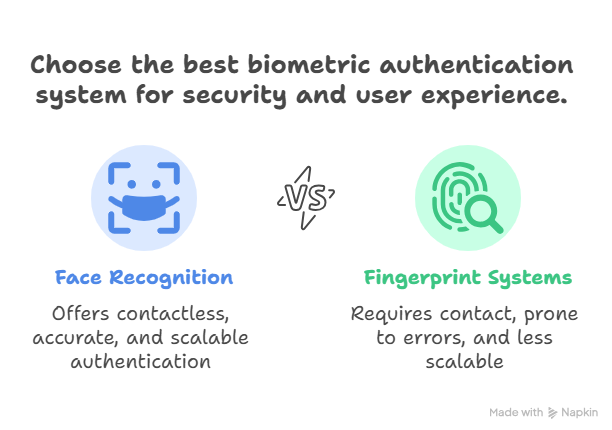
In modern setups, facial recognition has become one of the most popular biometric methods because it is contactless and easy to use in groups.
When you add intelligence on top of it, you get AI attendance. AI helps identify people faster, handle group images, reduce errors, and detect fraud attempts.
In simple terms, the system checks “who you are” instead of “what card you carry” or “what PIN you type.”
How Biometric Attendance Works (Step by Step)
The core idea of biometric attendance is simple, even if the technology behind it is advanced.
- Enrollment
Each user is registered once.- The system scans their fingerprint or captures their face.
- It converts this into a secure digital template, not a raw image.
- Verification
When the person arrives, they:- Place their finger on a scanner, or
- Look at a camera for facial recognition.
- Matching
The system compares the new scan with stored templates.
If it finds a match, it confirms identity in a fraction of a second. - Attendance Marking
The system logs in-time, date, and sometimes location.
When they leave, it records out-time as well. - Reporting
HR, admin, or management can view daily, weekly, or monthly attendance reports for each person, team, or department.
When AI is involved, the entire process gets smarter. AI attendance can handle poor lighting, angle differences, partial visibility, and still match faces accurately.
Why Organizations Are Moving to Biometric Attendance
1. Stops Proxy and Buddy Punching
In many places, people mark attendance for absent friends by sharing cards or PINs. This is called buddy punching. It leads to fake working hours and payroll loss.
A Biometric attendance system almost eliminates this. You cannot share your fingerprint or face. The system checks the real person every time. This builds fairness for both employees and employers.
2. Improves Accuracy and Reduces Errors
Manual registers have issues:
- Handwriting is unclear.
- Rows and columns shift.
- People forget to sign.
- Data entry mistakes happen when someone types reports later.
Biometric and AI attendance systems mark everything digitally in one go. Time is captured accurately. There is no need to rewrite or re-enter data. This reduces human error and gives clean records.
3. Saves Time Daily
Traditional methods waste valuable time during sign-in and sign-out. Long queues at a single device or a front desk are common.
With biometric and AI-based systems:
- Verification is quick.
- Contactless face recognition works even faster.
- In some setups, group attendance through face detection is possible for classrooms or training sessions.
Over weeks and months, these small time savings turn into big productivity gains.
Biometric vs AI-Based Attendance: What’s the Difference?
Many people mix these terms, but there is a simple difference.
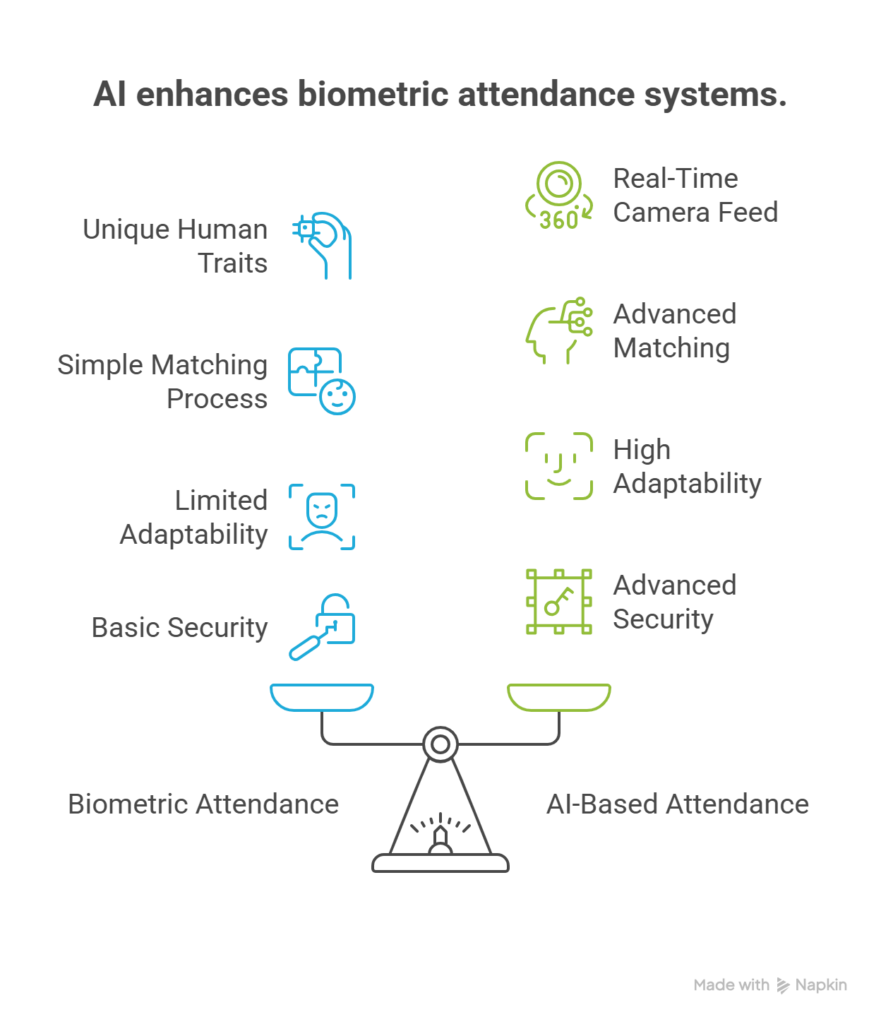
- Biometric attendance is about using unique human traits (like fingerprints or face).
- AI attendance is about using artificial intelligence to make that process smarter, faster, and more flexible.
AI can:
- Match faces in real time from a camera feed.
- Handle group photos for class or meeting attendance.
- Work better in different lighting and angles.
- Detect spoof attempts (for example, using a photo instead of a real face).
In today’s world, most modern systems are moving toward AI-powered biometric attendance, especially face recognition.
Biometric Attendance System: Pros and Cons
Here is a simple table that compares biometric attendance with older methods:
| Feature | Manual / Card-Based Methods | Biometric Attendance with AI attendance |
|---|---|---|
| Identity verification | Card, PIN, signature | Fingerprint, face, or iris |
| Proxy / buddy punching | Easy with shared cards or PINs | Very difficult, unique biometrics |
| Speed | Can be slow in queues | Fast, often under a second per person |
| Contactless option | Limited | Yes, especially with facial recognition |
| Data accuracy | Depends on manual handling | High, system-driven |
| Record storage | Paper files or basic sheets | Digital, secure, and backed up |
| Reporting | Manual compilation | Instant, auto-generated reports |
| Scalability | Hard to manage across many sites | Easy to scale with centralized systems |
This shows why Biometric attendance plus AI attendance has become a default choice for modern organizations.
Use Cases of Biometric Attendance
Corporate Offices
Companies use biometric systems to:
- Track employee attendance accurately.
- Support fair salary calculation, overtime, and shift payments.
- Restrict access to sensitive areas based on identity.
Schools, Colleges, and Institutes
Educational institutes use biometric or AI-based face attendance to:
- Track student presence by class and subject.
- Maintain records for exams, internal marks, and certifications.
- Inform parents about attendance patterns.
Here, AI-based facial recognition is very powerful because it works in group scenarios like classrooms.
Government and Large Public Institutions
Public offices and large programs use biometric systems to:
- Reduce ghost employees.
- Ensure that staff actually report on duty.
- Build transparent and traceable attendance records.
Security and Privacy in Biometric Attendance
Because biometric data is sensitive, security and privacy are very important.
A good Biometric attendance system should:
- Store biometric data as encrypted templates, not raw images.
- Protect data with strong access controls and role-based permissions.
- Use secure communication when sending data to servers or the cloud.
- Follow data protection guidelines and delete data when no longer needed.
When done correctly, biometric systems can be safer than paper registers, which anyone can open and read.
How DutyPar Is Doing Great in This Field
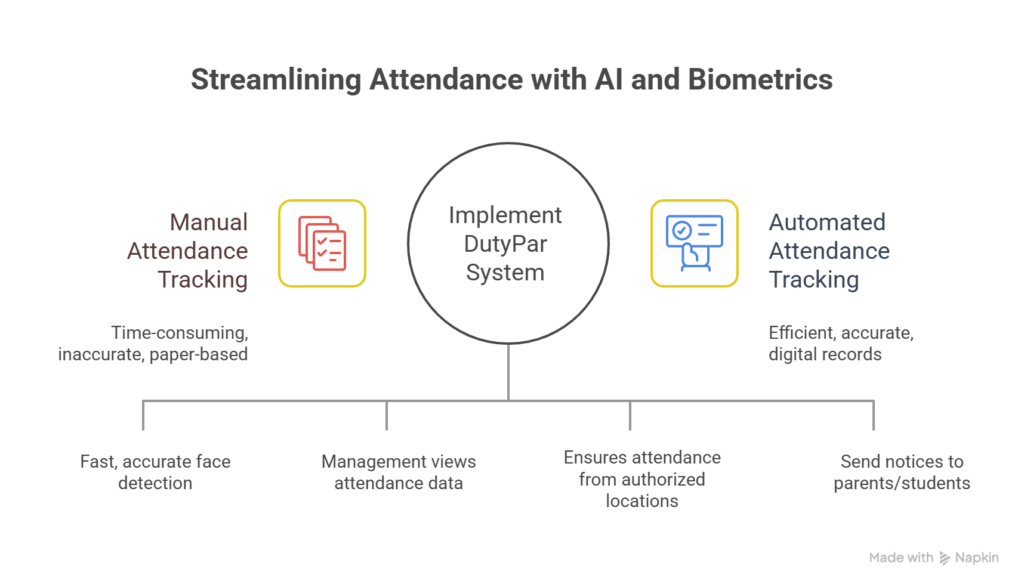
DutyPar, built by IndoAi Technologies, is a strong example of how AI and biometrics can be used effectively for attendance in education and training environments.
DutyPar focuses on face-based AI attendance designed for teachers, students, and staff. It allows:
- Teachers to mark group attendance by capturing row-wise or full-class photos.
- Fast processing, where the system detects and recognizes faces in seconds.
- Accurate records of in-time, out-time, and class-wise presence.
DutyPar also offers:
- Real-time dashboards for management to view attendance across classes, grades, or campuses.
- Geo-tagged attendance to ensure marking happens only from authorized locations.
- Announcement tools so schools can send notices and messages to parents and students through the same platform.
Institutes that use DutyPar save hours of teaching time each year because teachers do not need to call out names or handle paper registers. This makes classroom time more focused on learning while still keeping attendance data clean and reliable.
DutyPar shows how Biometric attendance with AI, when built thoughtfully, can work smoothly at scale and support real-world needs in a simple, human-friendly way.
Is a Biometric Attendance System Right for You?
You should consider moving to biometric and AI attendance if:
- You still use paper registers, cards, or manual logs.
- You face issues with proxy attendance, late arrivals, or missing records.
- You spend too much time preparing attendance reports.
- You manage multiple branches, offices, or campuses.
With the right system, you get:
- More accurate attendance.
- Less manual work for HR, teachers, or admins.
- Better transparency for employees, students, and parents.
- Stronger support for audits, payroll, and compliance.
Final Thoughts
A Biometric attendance system is no longer just a “nice to have” tool. It has become a core part of how modern organizations run day-to-day operations. By combining biometrics with AI attendance, you get a smart, secure, and scalable solution that saves time, prevents fraud, and builds trust.
When providers like DutyPar focus on simple design, strong technology, and real use cases, biometric attendance becomes easy to adopt and even easier to use. If you want cleaner records, smoother processes, and a more professional image, upgrading to an AI-powered biometric attendance system is one of the most impactful steps you can take.