
Table of contents
- What Is AI Attendance?
- Why Accurate Employee Attendance Is the Base of Compliance
- 1. AI Attendance Prevents Proxy and Buddy Punching
- 2. Precise Time Stamping Supports Labor Law Compliance
- 3. Digital, Tamper-Resistant Records for Audits
- 4. Central Control for Multi-Site and Remote Teams
- 5. Real-Time Monitoring Helps You Act Before There Is a Problem
- 6. Clear Policies Built Into the System
- 7. Fewer Attendance Disputes, More Trust
- 8. Data Security and Privacy as Part of Compliance
- DutyPar: A Practical Example of Compliance-Friendly AI Attendance
- Compliance with and without AI Attendance
- Final Thoughts: AI Attendance as a Compliance Partner
Compliance is not just about rules and fines. It is about trust, fairness, and clear records. When employee attendance data is wrong or incomplete, everything suffers – payroll, audits, safety, and team morale. That is why many organizations are now turning to AI attendance systems to manage attendance in a smarter and more reliable way.
This blog explains, in simple language, how AI-based attendance systems improve compliance, protect your business, and make life easier for HR, managers, and employees.
What Is AI Attendance?
AI attendance means using artificial intelligence to track and manage employee attendance automatically.
Instead of signing a register, tapping a card, or typing into a sheet, employees just:
- Look at a camera
- Or use a mobile app
- Or walk through an AI-enabled gate
The system then:
- Recognizes their face or identity
- Records in-time and out-time
- Stores the attendance in a secure database
This removes manual effort and reduces the chance of human error. It also creates a clear and consistent digital trail, which is very important for compliance.
Why Accurate Employee Attendance Is the Base of Compliance
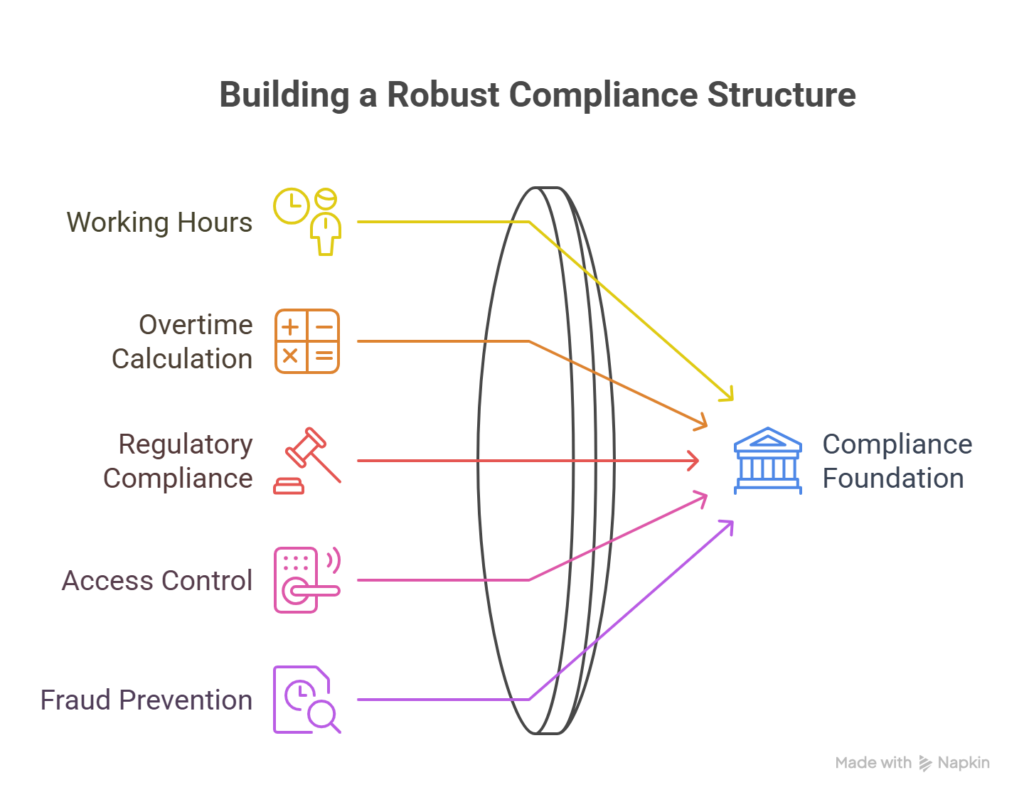
Many laws and internal policies depend on correct employee attendance data. Accurate attendance helps you:
- Prove working hours and break times
- Calculate overtime in a fair way
- Show regulators that you follow labor rules
- Control who enters certain areas
- Avoid fake attendance and time theft
If your attendance system is weak, your compliance foundation is weak too. AI attendance gives you a stronger, cleaner base.
1. AI Attendance Prevents Proxy and Buddy Punching
One of the biggest risks with traditional attendance is proxy marking. A friend can punch a card or sign for someone who is late or absent. This creates false records and can damage compliance with work-hour rules and payroll accuracy.
With AI attendance, the system uses face recognition or other AI checks to verify identity. It does not just trust a card or ID number. It looks at the person.
That means:
- Only the real employee can mark their own attendance
- Time theft and proxy attendance become very hard
- Records show actual presence, not just card activity
This protects the company from fake overtime claims and incorrect work-hour reports.
2. Precise Time Stamping Supports Labor Law Compliance
Many labor laws and company policies talk about:
- Maximum working hours per day or week
- Minimum break times
- Overtime thresholds
To prove that you follow these rules, you need exact in-time and out-time. Manual systems often depend on memory, rushed entries, or delayed updates.
An AI-based employee attendance system:
- Captures time automatically when the employee is verified
- Saves the exact second, not just an approximate time
- Applies the same rules to everyone
This precision helps you prove that you respect working-hour limits and break policies. It also reduces disputes about overtime and late marks.
3. Digital, Tamper-Resistant Records for Audits
Compliance is not only about doing the right thing. It is also about being able to show you did the right thing.
Paper registers can:
- Get lost
- Be altered
- Be hard to read
Spreadsheets can:
- Be edited without a clear history
- Exist in many versions
An AI attendance system stores employee attendance data in a secure digital database. Many solutions:
- Keep logs of who accessed or changed what
- Restrict editing rights to specific roles
- Create automatic backups
So when an auditor or authority asks for attendance records, you can:
- Export clean reports
- Show history and logs
- Prove consistency over time
This builds confidence and reduces the stress of audits.
4. Central Control for Multi-Site and Remote Teams
Today, many companies work across:
- Multiple branches
- Client locations
- Remote and hybrid setups
Managing employee attendance manually in such setups makes compliance very hard.
With AI attendance:
- Each site or device sends attendance data to a central system
- HR and management see all locations on one dashboard
- Policies can apply across branches in a uniform way
If a law or internal rule changes, you update it once in the system. The new rule flows automatically to each location. This keeps compliance consistent, not dependent on local habits or manual processes.
5. Real-Time Monitoring Helps You Act Before There Is a Problem
Compliance problems often start small:
- Too much overtime in a team
- Repeated late coming in a sensitive role
- People staying beyond allowed hours
If you see this only in a monthly report, it is often too late.
AI attendance systems offer real-time or same-day visibility. Managers and HR can:
- View who is inside the premises right now
- Track daily working hours as they grow
- Receive alerts if someone crosses a defined limit
This lets you act early:
- Adjust shifts
- Ask someone to log off on time
- Balance workload across teams
Preventing a violation is always better than explaining it later.
6. Clear Policies Built Into the System
Good compliance is not only about data. It is also about rules.
AI attendance platforms can embed your policies inside the system. For example:
- Mark late after a certain time
- Count overtime only after a fixed threshold
- Flag attendance from unapproved locations or devices
This way, the system itself helps enforce rules. Supervisors do not need to remember every detail. They simply follow what the system shows.
Employees also understand expectations better when they see clear logic in their attendance and salary calculations.
7. Fewer Attendance Disputes, More Trust
Disputes about employee attendance and pay are common:
- “I was present, but it shows absent.”
- “My overtime count is wrong.”
- “The register was not updated that day.”
AI attendance reduces these issues because:
- Data comes from an impartial system, not from memory
- Time stamps and logs show what really happened
- Both HR and employees can refer to the same source of truth
When people trust the attendance system, they trust payroll and HR more as well. This indirectly strengthens compliance culture in the company.
8. Data Security and Privacy as Part of Compliance
Attendance data is personal data. In the case of face recognition, it is also sensitive biometric data.
A responsible AI attendance solution supports compliance by:
- Storing biometric templates securely, not raw images
- Using encryption for data in storage and in transmission
- Limiting access with strong authentication and role-based permissions
- Allowing data deletion or anonymization when an employee leaves
This helps you respect privacy expectations and stay aligned with data protection rules and best practices.
DutyPar: A Practical Example of Compliance-Friendly AI Attendance
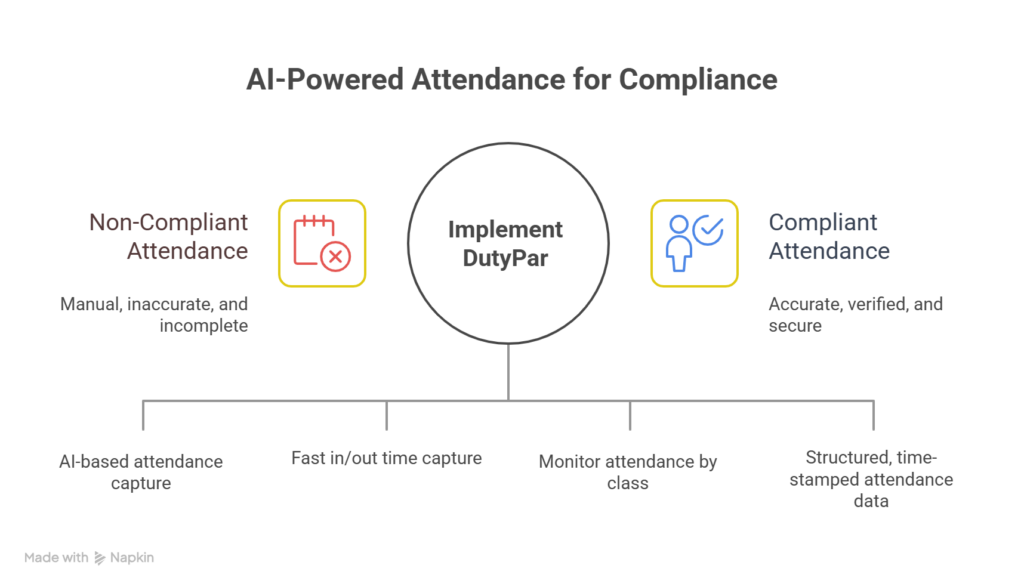
DutyPar is a live example of how AI-based attendance can support compliance in real environments like educational institutes and training setups.
We focuses on:
- Face recognition–based AI attendance for teachers, staff, and students
- Fast in-time and out-time capture through mobile apps and AI cameras
- Class-wise and location-wise attendance dashboards that management can monitor in real time
- Row-wise and group attendance features that save time while still creating accurate digital records
With DutyPar:
- Institutes can prove which students or staff were present on any given day or period
- Admin teams get downloadable attendance reports for audits, inspections, and internal reviews
- The system helps prevent proxy attendance and missing records
Because the records are digital, structured, and time-stamped, they support better compliance with academic rules, training requirements, and government schemes that depend on verified attendance.
DutyPar’s focus on secure architecture and large-scale deployments also shows that AI-powered employee attendance is not just a future idea. It is a working, trusted solution today.
Compliance with and without AI Attendance
| Compliance Area | Without AI Attendance | With AI Attendance System |
|---|---|---|
| Identity verification | Cards, signatures, easy to share | Face or AI-based verification |
| Proxy / buddy punching | Common and hard to detect | Strongly reduced, often eliminated |
| Time accuracy | Approximate, manual entries | Exact, automatic time stamps |
| Record security | Paper or basic files, easy to alter | Secure, logged, role-based access |
| Audit readiness | Needs manual sorting and cleaning | Ready-made, exportable digital reports |
| Multi-site consistency | Depends on each location’s discipline | Central rules and unified tracking |
| Early detection of issues | Seen late in reports | Seen early via real-time dashboards |
| Trust and transparency | Often questioned by staff | Higher trust due to system-based records |
Final Thoughts: AI Attendance as a Compliance Partner
AI attendance is more than a tech upgrade. It is a compliance partner for your organization.
By:
- Preventing proxy attendance
- Capturing accurate time data
- Creating secure digital records
- Supporting multi-location control
- Reducing disputes
- Protecting privacy
an AI-based employee attendance system makes compliance simpler, stronger, and more transparent.
If your goal is to reduce risk, make audits easier, and build trust with employees and regulators, then AI attendance is one of the smartest systems you can adopt. Solutions like DutyPar show that when AI is used correctly, it can turn attendance from a daily headache into a powerful source of compliance and insight.