


Table of contents
In schools, colleges, and workplaces, there is an issue with “Proxy Attendance”, whereby a student or worker has another person mark his attendance instead of being present for their own. While this may seem harmless initially, proxy attendance has negative effects on the Discipline of the student or employee; the learning ability of the student; and, in an employment matter, payroll issues for the employee. Many institutions have begun to adopt an “AI Attendance” system to combat this problem by eliminating the ease of cheating through proxy attendance while simplifying the process of verifying actual attendance.
This blog explains what Proxy Attendance is, why it hurts your system, and how AI Group Attendance can stop it in a practical, simple way that anyone can understand.
What Is Proxy Attendance?
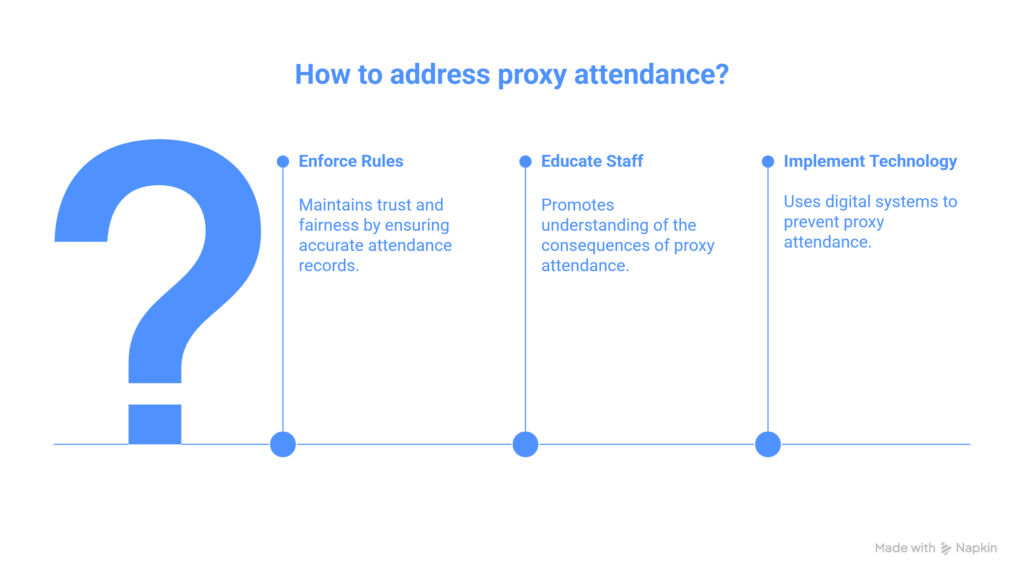
Proxy Attendance means marking presence for someone who is actually absent. A friend answers the roll call. A coworker punches the card for someone who came late. A student shares their ID card with someone else.
It looks like a shortcut, but it creates deep issues:
- It breaks trust between management and students or staff.
- It gives an unfair advantage to people who skip work or class.
- It makes attendance records false and useless.
- It impacts grades, salary, and even compliance with rules.
When Proxy Attendance becomes common, people stop taking rules seriously. That is why stopping it is so important for any serious organization.
Why Traditional Attendance Systems Fail?

Old attendance methods are easy to cheat. That is the main reason Proxy Attendance still exists.
- Paper Registers: A friend can say “present” for someone else. Teachers are busy. They often cannot verify every voice or face in a large classroom.
- ID Cards / RFID: Someone can swipe a friend’s card. This is very common in colleges and offices.
- Fingerprint Devices: They are better, but still not perfect. People stand close and press their fingers for others if operators are not careful. Devices can also break down or give errors.
All these methods only check some form of access, not the real person behind it. That is where AI Attendance changes the game.
How AI Attendance Helps Stop Proxy Attendance
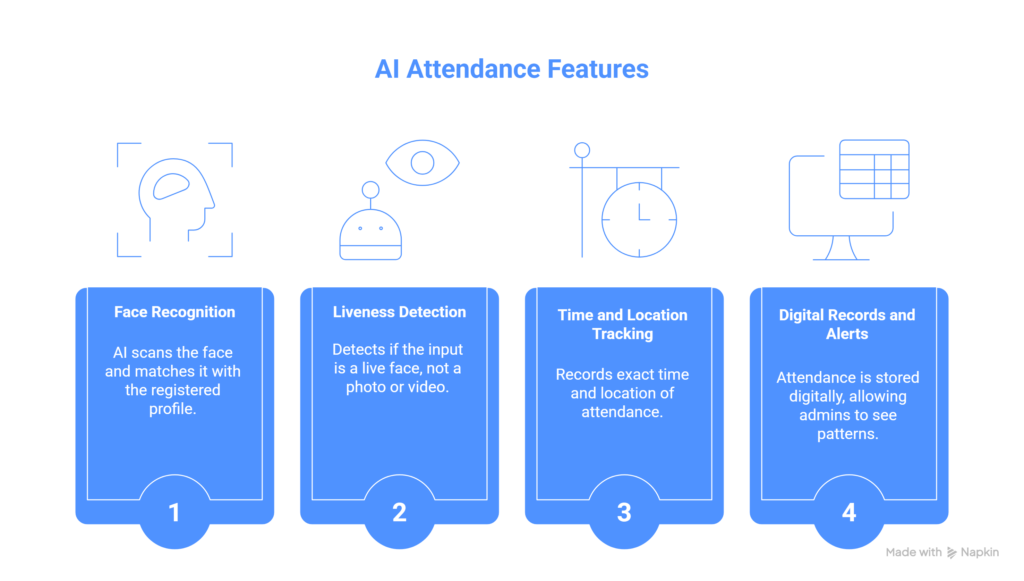
An AI Attendance system uses face recognition and smart automation to identify the real person present at the time of attendance. It does not depend on cards, signatures, or tokens that others can share.
Here is how AI Attendance helps:
- Face Recognition Instead of ID Sharing
AI scans the face and matches it with the registered profile. Only the actual person can pass this check. No friend can do it on their behalf. - Liveness Detection
Advanced systems can detect if the input is a live face, not a photo or video. This stops people from using printed photos or screen images to fool the system. - Time and Location Tracking
The system records exact time and location of attendance. This proves not just who was present, but also where and when they were present. - Digital Records and Alerts
Attendance is stored digitally. Admins can see patterns like sudden perfect attendance after a history of frequent absence, and then investigate if needed.
When you combine these features, AI Attendance makes Proxy Attendance extremely hard, almost impossible in practical terms.
Simple Strategies to Stop Proxy Attendance
To stop Proxy Attendance, you need both technology and policy working together.
1. Move to Face-Based AI Attendance
The biggest step is switching from manual or ID-based systems to a face recognition–driven AI Attendance system. When the system verifies faces, it verifies real presence.
This can work in two modes:
- Individual attendance on a device or app.
- Group attendance using a camera or mobile, where the system recognizes multiple faces at once.
Both modes close the door on card sharing and voice-based proxy.
2. Use Liveness Checks
To prevent people from using photos or videos, enable liveness checks in your AI Attendance tool. This may include:
- Asking the user to blink.
- Detecting slight movements.
- Checking depth or texture.
These checks ensure that the system is seeing a real human, not a still image.
3. Link Attendance with Geo-Location
Geo-tagging adds another layer of security. You can ensure that attendance is marked only inside the campus, office, or authorized classroom.
Even if someone tries to mark attendance from home using another person’s device, the system can reject it based on location rules.
4. Set Clear Policy and Communication
Technology works best when rules are clear. Tell students or employees:
- Proxy Attendance is a serious violation.
- The institute or company uses AI Attendance to protect fairness.
- Repeated Proxy cases may lead to action.
When people know both the technology and the policy are strong, they think twice before cheating.
Proxy Attendance vs AI Attendance
Here is a simple comparison showing why AI Attendance is much better at stopping Proxy Attendance:
| Aspect | Traditional Attendance | AI Attendance (Face-Based) |
|---|---|---|
| Main Method | Voice call, ID card, signature, finger | Facial recognition with AI |
| Proxy Possibility | Very high | Extremely low |
| Can Friend Mark for You? | Yes, easily | No, system checks your own face |
| Use of Photos or Videos | Often possible | Blocked with liveness detection |
| Location Verification | Usually not available | Possible with geo-tagging |
| Data Accuracy | Error-prone and inconsistent | Clean, consistent, and reliable |
| Tampering Risk | High (manual changes) | Very low (system logs all actions) |
| Reporting | Slow and manual | Instant and automatic |
How DutyPar Is Helping to Stop Proxy Attendance
DutyPar is a good example of how an AI-powered attendance solution can work effectively in real educational environments. DutyPar focuses on face recognition–based AI Attendance for teachers and students. It helps schools, colleges, and training centers:
- Use camera-based face recognition instead of ID cards or signatures.
- Take row-wise or full-class group photos and let the system mark AI-based attendance for everyone in seconds.
- Ensure attendance is marked only from authorized places by using location data.
- Provide real-time dashboards where administrators can see who is present, which class is running, and which students are absent.
By combining face recognition, group attendance, and real-time tracking, DutyPar makes Proxy Attendance extremely difficult. Students cannot simply ask a friend to “give proxy” because the system checks faces, not voices or ID cards.
DutyPar also gives clear digital records. This helps:
- Teachers see attendance trends for each student.
- Management identify unusual patterns quickly.
- Parents stay informed about their child’s presence in school.
This mix of technology and transparency builds a culture where honesty becomes the default, and Proxy Attendance has no place.
Stopping Proxy Attendance the Smart Way
Proxy attendance is more than a minor issue affecting willingness, belief, and success. Any old form of attendance management systems that utilize “something you own” (like an ID) or “something you can claim” (like roll call) simply cannot provide protection against this, because they do not verify “who you are”. AI attendance systems provide an improved way to verify that a student is present in real time by recognizing their face as a distinct, secure identity instead of using either “something you own” (an ID) or “something you claim” (roll call). AI attendance systems not only use facial recognition but also include liveness detection and geolocation, resulting in proxy attendance becoming nearly impossible to generate consistently.
When utilised together with explicit governing rules and a product like DutyPar (that is already in use by several educational institutions), you have an effective and efficient way to eradicate proxy attendance and create a trustworthy, contemporary, and dependable attendance management system.