


Table of contents
- What Is a GPS Attendance System?
- Why GPS Attendance Matters for Modern Organizations
- How GPS Attendance Works in Simple Steps
- Benefits of GPS Attendance for Businesses and Institutes
- GPS Attendance vs Traditional Attendance
- Combining AI Attendance with GPS: A Powerful Duo
- Use Cases of GPS Attendance
- How DutyPar Uses GPS and AI Attendance for Education
- GPS Attendance and Compliance
- Things to Keep in Mind When Using GPS Attendance
- Final Thoughts: Why GPS Attendance Is the Future of Mobile Work
A GPS attendance system makes it easy to know not only when someone is present, but also where they are when they mark attendance. This is very useful for field staff, remote teams, on-site workers, and even teachers or trainers moving across locations. When you combine GPS Attendance with AI attendance, you get a powerful, reliable, and flexible way to track work in the real world.
This blog explains how GPS-based attendance works, why it matters, and how it helps organizations manage people with more confidence and control, in a simple and human way.
What Is a GPS Attendance System?
A GPS attendance system uses the location services of a mobile phone or device to track employee attendance at specific places.
When a user marks attendance through an app, the system captures:
- The exact time
- The GPS location coordinates
- Sometimes additional data like photo or face verification
This is very helpful when people do not work at a fixed desk or office. For example:
- Sales executives visiting clients
- Field trainers and survey teams
- Teachers or staff at branch campuses
- Maintenance or service teams in different areas
When AI is added, AI attendance can also verify who is marking attendance, while GPS confirms where they are.
Why GPS Attendance Matters for Modern Organizations
In many businesses today, work does not happen only inside a single building. People work:
- On the road
- At client sites
- In different branches
- On project locations
Traditional biometrics or paper registers do not fit this reality. They only work when people come to a fixed point.
A GPS attendance flow solves this problem by turning a smartphone into a mobile attendance device. As long as the person has the app and internet, they can mark attendance from wherever they are allowed to work.
This gives organizations clear visibility of:
- Who worked
- When they worked
- Where they worked
All in one system.
How GPS Attendance Works in Simple Steps
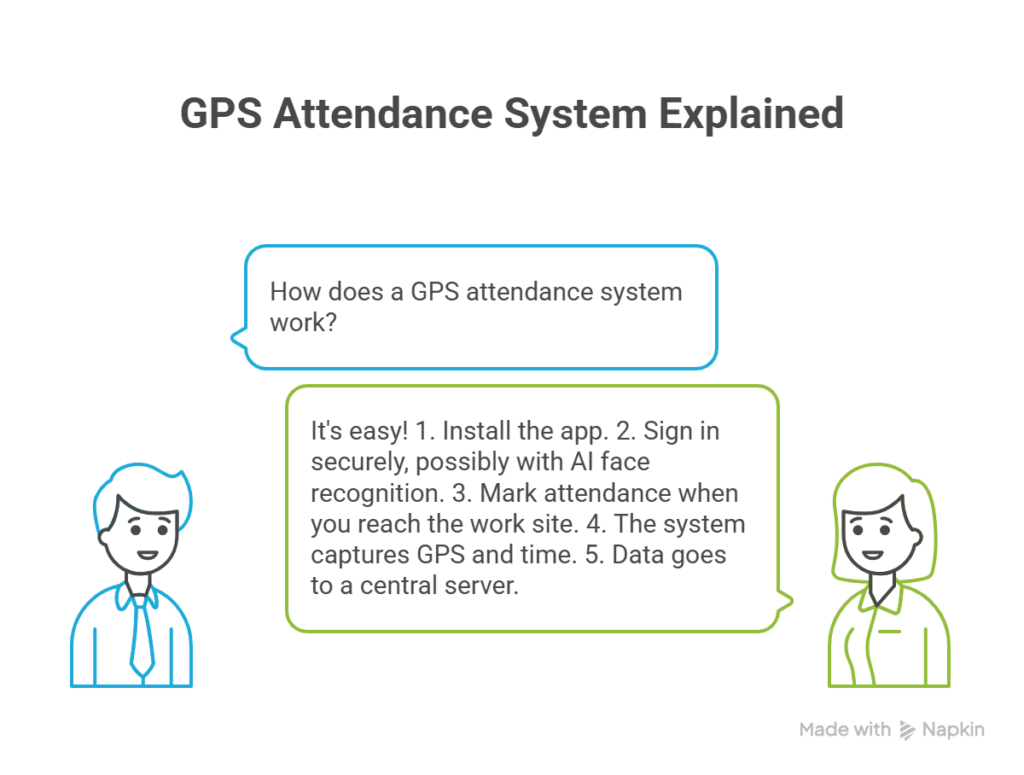
Even though it uses technology, a GPS attendance system is easy to use for normal users.
- Install the app
Employees or staff install the official attendance app on their smartphones. - Sign in securely
They log in with their credentials. In some setups, AI attendance with face recognition confirms identity. - Mark attendance from the location
When they reach the work site (office, school, client location), they open the app and tap “Mark In” or “Mark Attendance.” - System captures GPS and time
The app reads the GPS location, checks if it is within the allowed zone, and records the time. - Data goes to central server
Attendance records sync to a central dashboard for HR or admin to review.
The same process happens at the end of the day or shift for “Mark Out.”
Benefits of GPS Attendance for Businesses and Institutes
1. Location-Verified Attendance
With GPS attendance, you do not rely on trust alone. The system confirms that the person was at the right place when they marked attendance.
- No one can mark attendance from home if they are supposed to be at a client site.
- Staff cannot say they were on-site if GPS logs show they were somewhere else.
This builds accountability and reduces false claims.
2. Better Control Over Remote and Field Teams
For companies with field sales, delivery staff, or on-site workers, AI attendance combined with GPS gives strong control.
- Managers can see a map-based view of who checked in where.
- Admins can monitor attendance for each region or territory.
- It becomes easier to track coverage, presence, and productivity.
Instead of asking for manual reports, managers see real-time data.
3. Accurate Working Hours and Travel Patterns
A GPS attendance system helps calculate:
- Exact check-in and check-out time
- Time spent at specific locations
- Total working hours in the field
This is useful for fair salary calculation, travel reimbursements, and performance assessments. When data is clear and system-based, disputes are reduced.
GPS Attendance vs Traditional Attendance
Here is a simple table you can also use in your own content:
| Feature | Traditional Attendance | GPS Attendance System |
|---|---|---|
| Location tracking | Not available | Yes, with GPS coordinates |
| Suitable for field staff | Difficult | Very suitable |
| Device used | Register, biometric device, desktop | Smartphone or tablet |
| Time accuracy | Depends on manual action | System-level, precise time stamps |
| Proxy or fake location | Easy to fake “I was there” claims | Hard to fake due to GPS and AI checks |
| Reporting | Manual and slow | Automatic and real-time |
| Remote work support | Poor | Strong, suitable for hybrid and mobile work |
This is why many organizations are moving from fixed hardware to app-based GPS attendance solutions.
Combining AI Attendance with GPS: A Powerful Duo
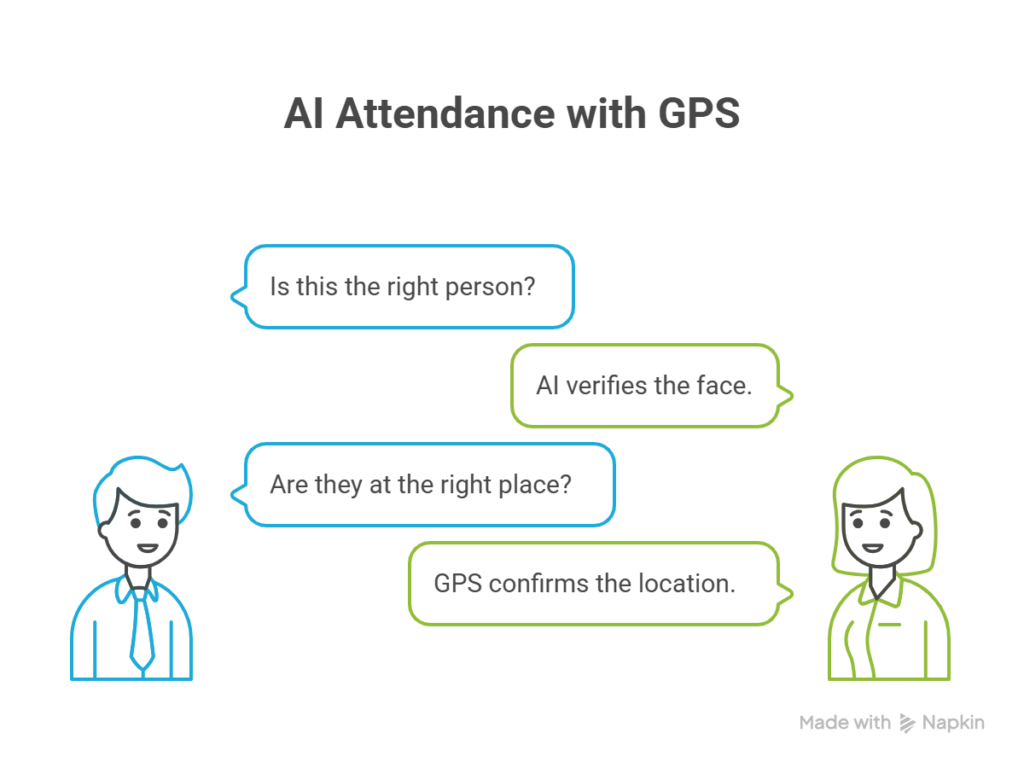
When you mix AI attendance with GPS, you solve two big questions at once:
- “Is this the right person?”
- “Are they at the right place?”
AI verifies the face, while GPS confirms the location.
This is very useful in sensitive environments like:
- Educational institutes tracking teacher and student presence
- Government projects needing proof of on-ground work
- Large enterprises managing distributed teams
The result is a high-trust attendance record that works both for operations and for audits.
Use Cases of GPS Attendance
Field Sales and Service
Sales executives, medical reps, or service engineers often move between locations. GPS attendance ensures that:
- Check-ins happen at the client site, not from a random place.
- Management can see which areas were actually covered.
Construction and On-Site Projects
Workers and supervisors at project sites do not always have access to biometric machines. With app-based GPS attendance, they can mark attendance on-site using mobile devices.
Multi-Campus or Branch-Based Institutes
Schools, colleges, or training centers with multiple campuses can use GPS to ensure staff and even visiting teachers mark presence only at approved locations.
How DutyPar Uses GPS and AI Attendance for Education
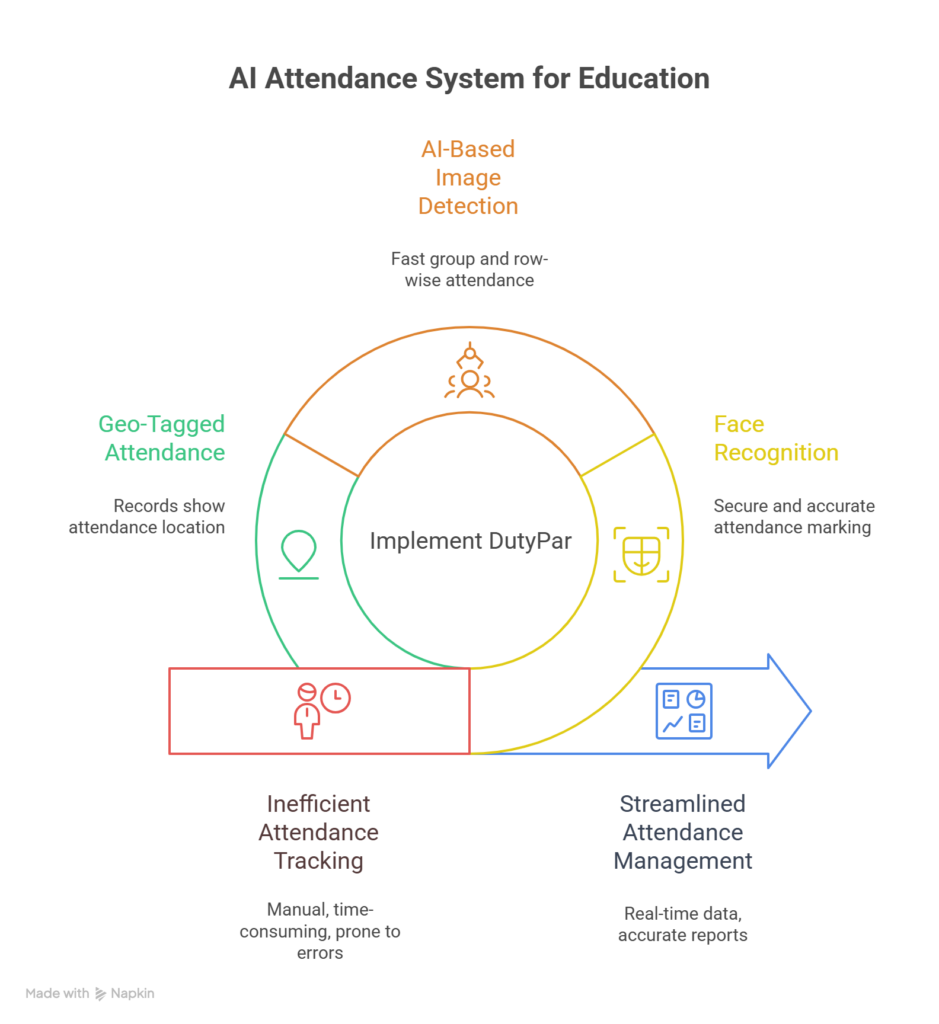
DutyPar, designed for educational institutes, is a good example of how AI attendance and location-based tracking come together for real value.
DutyPar focuses on:
- Face recognition-based attendance for teachers and students.
- Fast group and row-wise attendance in classrooms using AI-based image detection.
- Geo-tagged attendance, so records show from which campus or location attendance was marked.
This means that:
- A teacher marking attendance using DutyPar can only do so from an approved location like the school campus.
- Management sees real-time attendance data from multiple classes and locations in one dashboard.
- Institutes get accurate reports for compliance, audits, and academic tracking.
DutyPar shows that GPS and AI, when designed well, can save time, reduce fraud, and give real visibility to school and college administrators.
GPS Attendance and Compliance
Compliance and audits depend on clean records. A GPS attendance system helps organizations:
- Prove that employee attendance or staff presence happened at specific locations.
- Show time-bound records with both time and location stamps.
- Reduce chances of fake attendance claims during inspections or verifications.
When systems keep logs securely and generate reports automatically, compliance becomes easier and more reliable.
Things to Keep in Mind When Using GPS Attendance
While GPS-based systems are powerful, they should be used thoughtfully.
- Clear Policies
Tell employees or staff how the GPS attendance works, what data is collected, and why. Transparency builds trust. - Privacy Respect
Use GPS data only for attendance and work-related tracking. Avoid unnecessary tracking after work hours. - Battery and Connectivity
Make sure the app is optimized so it does not drain too much battery and can handle low-network conditions smartly. - Allowed Zones
Configure the system so that attendance is valid only within certain distance ranges around approved locations.
When these points are handled, GPS-based systems work smoothly and fairly.
Final Thoughts: Why GPS Attendance Is the Future of Mobile Work
The way we work is changing. More people are on the move, working from client locations, branches, or remote setups. Old attendance systems built for fixed offices no longer match this reality.
A GPS attendance system, especially when paired with AI attendance, gives organizations a modern, flexible, and reliable way to track presence with both time and location. It supports fair pay, accountability, and compliance, while reducing paperwork and manual effort.
For institutes and companies that want a real, working example, solutions like DutyPar show how GPS and AI can be used together in daily operations. If your teams are mobile or spread across locations, GPS attendance is not just a nice feature. It is becoming a must-have tool for smart, transparent, and efficient management.