


Table of contents
- What Is an Automated Assessment System?
- How Automated Assessment Systems Work (In Simple Terms)
- Why Automated Assessment Systems Are Becoming Essential
- Automated Assessment and AI Attendance: A Smart Combination
- Key Features of a Good Automated Assessment System
- Automated Assessment vs Traditional Assessment
- Why Automated Assessment Matters for Skill-Based Learning
- How DutyPar Supports Automated Assessment and Smart Campuses
- Making Automated Assessment Simple for Users
- Best Use Cases for Automated Assessment Systems
- Final Thoughts: Why Now Is the Right Time
Education and training are changing fast. Manual checking of tests, assignments, and exams takes a lot of time and often feels slow and unfair. An Automated Assessment System solves many of these problems. It uses technology and sometimes AI to check answers, track performance, and share results in a clear and quick way. When this works together with tools like AI Attendance, institutes get a complete smart campus experience.
This blog explains what an Automated Assessment System is, how it works, why it matters, and how platforms like DutyPar are already using it to support schools and training institutes.
What Is an Automated Assessment System?
An Automated Assessment System is a digital system that creates, delivers, checks, and records tests or assessments with minimum human effort.
It can be used for:
- Schools and colleges
- Coaching centers and test prep institutes
- Skill development programs
- Corporate training and internal exams
Instead of teachers or trainers checking each sheet by hand, the system:
- Delivers questions online or on a device
- Collects answers from each learner
- Uses rules or AI to evaluate responses
- Shares results and feedback almost instantly
It reduces manual work and gives faster, more accurate outcomes.
How Automated Assessment Systems Work (In Simple Terms)
The core idea is simple. The system moves assessment from paper to a structured digital flow.
- Test Creation
Teachers or trainers create a question bank. It can include multiple choice questions, true/false, short answers, and sometimes even long-form answers. - Test Delivery
The system schedules tests and delivers them online or in a controlled environment. Learners log in with secure credentials and complete their exams. - Automatic Evaluation
For objective questions (like MCQs), the system checks answers instantly based on the answer key.
For higher-level systems, AI can also help score essays, written responses, or coding questions based on set rules and patterns. - Results and Feedback
The system generates scores, analysis, and sometimes personalized feedback. It can show topic-wise strengths and weaknesses for each learner. - Reports and Records
Admins can see class-wise, batch-wise, or organization-level performance. They can export reports, track improvement, and plan better teaching.
Everything happens with clear logs, timestamps, and secure storage.
Why Automated Assessment Systems Are Becoming Essential
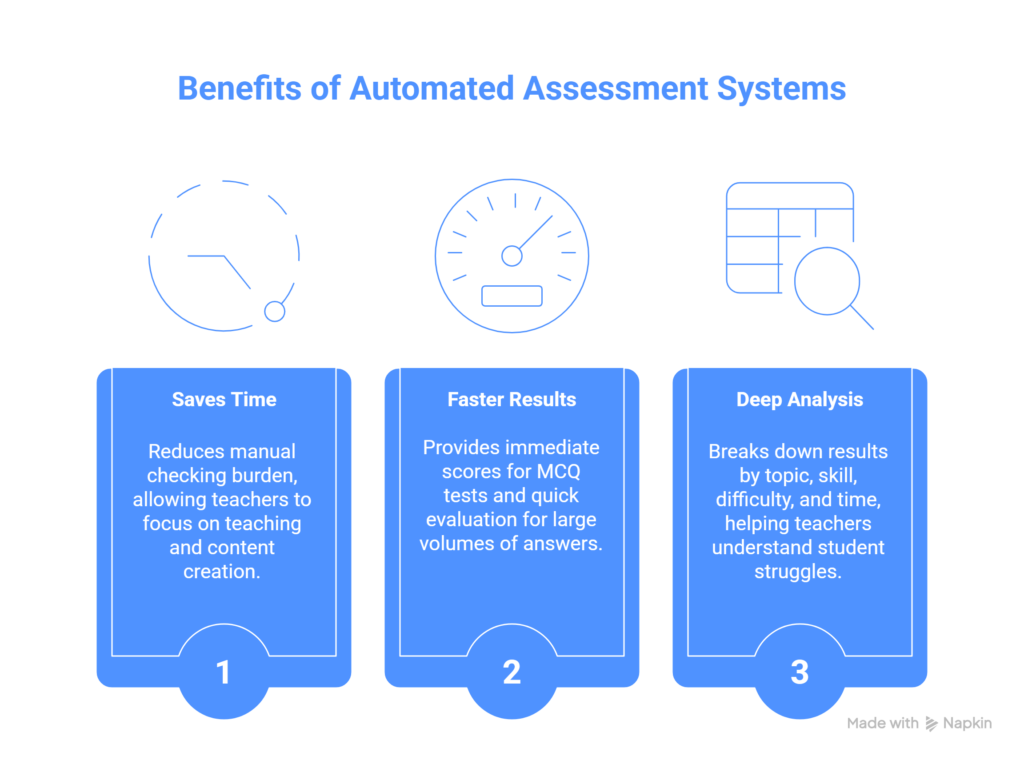
Saves Time for Teachers and Trainers
Manual checking is slow and tiring. An Automated Assessment System reduces this burden.
- Teachers can focus more on teaching, mentoring, and content creation.
- Trainers can spend more time on explanation and practice instead of paperwork.
This improves quality and satisfaction on both sides.
Gives Faster and Fair Results
Students and learners do not like waiting weeks for their results. Automated checks reduce this waiting time.
- MCQ-based tests can show scores immediately after submission.
- AI-based evaluation can check large volumes of answers in a short time.
This also reduces human bias and error. The same rules apply to everyone, which makes the process fair.
Helps in Deep Performance Analysis
An Automated Assessment System does more than just give marks. It can break down results by:
- Topic
- Skill type
- Difficulty level
- Time taken per question
This helps teachers understand where students struggle. They can then adjust their teaching and provide targeted support.
Automated Assessment and AI Attendance: A Smart Combination
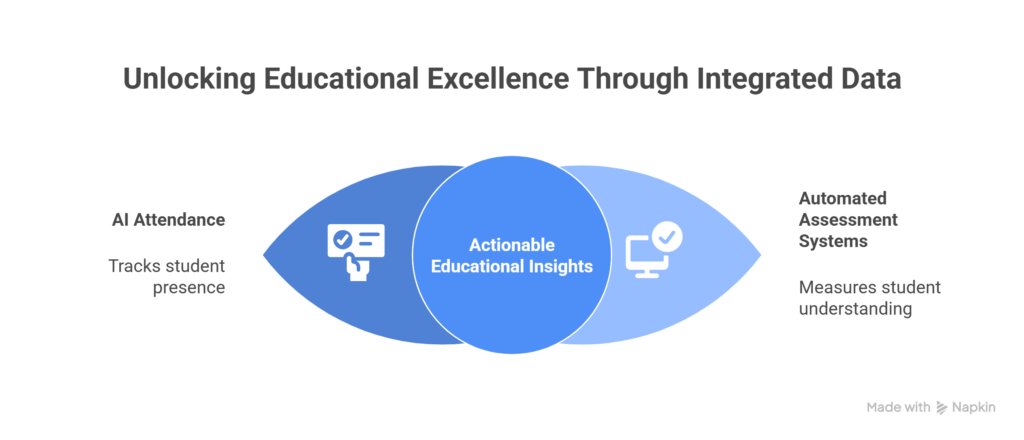
When institutes use both AI Attendance and automated assessments, they get a clear picture of both presence and performance.
- AI Attendance tracks who comes to class and for how long.
- Automated Assessment Systems track what learners understand and how they perform.
Together, these systems help answer key questions:
- Are regular students performing better than irregular students?
- Does attendance in certain classes relate to higher test scores?
- Which batches or branches need more academic support?
This kind of insight is very powerful for schools, colleges, and training organizations that want to improve quality.
Key Features of a Good Automated Assessment System
A modern Automated Assessment System often includes:
- Question bank management with tags and levels
- Randomized papers to reduce cheating
- Timed tests with auto-submit
- Support for images, diagrams, and multimedia in questions
- Detailed result dashboards for teachers, admins, and sometimes learners
- Secure login and identity verification
Some advanced systems also integrate proctoring with cameras and AI to monitor cheating during online exams.
Automated Assessment vs Traditional Assessment
Here is a simple comparison to see the difference more clearly:
| Aspect | Traditional Assessment | Automated Assessment System |
|---|---|---|
| Question delivery | Paper-based in classrooms | Online or device-based, controlled environment |
| Checking method | Manual by teachers | Auto-check for objective; rule/AI-based for others |
| Time to publish results | Days or weeks | Immediate or within hours |
| Risk of human error | High | Low, rules are consistent |
| Analysis and insights | Limited, mostly just total marks | Topic-wise, skill-wise, batch-wise details |
| Scaling to many learners | Difficult and slow | Easy to scale to thousands |
| Integration with AI Attendance | Usually separate or manual links | Possible to link and analyze together |
This shows why many modern institutes are slowly shifting to automated models.
Why Automated Assessment Matters for Skill-Based Learning
In skill development and vocational training, speed and scale matter a lot. There may be thousands of learners across states or regions.
An Automated Assessment System helps:
- Conduct the same standardized test across all centers.
- Maintain uniform scoring rules.
- Share results quickly with learners, trainers, and sponsoring bodies.
When combined with digital tracking of AI Attendance, it becomes easy to prove who attended, who passed, and who needs more practice.
How DutyPar Supports Automated Assessment and Smart Campuses
DutyPar is well-known for its smart AI Attendance and group attendance features for educational institutes. But it also moves beyond just attendance.
DutyPar supports an Automated Assessment System approach by offering:
- An AI-driven assessment platform that delivers instant results, feedback, and rewards to learners.
- Tools that help predict learner behavior and performance patterns using data.
- Question bank-based assessments, where the system can pick questions using a randomizer so that each learner’s test is unique yet balanced.
- AI support to find the most relevant questions from the bank for a given topic or skill level.
This means institutes using DutyPar can manage both attendance and assessments on connected digital rails. Teachers and admins do not need separate systems for everything. They can:
- Track attendance through AI-powered face recognition.
- Conduct tests through the same ecosystem.
- See attendance and assessment data together for smarter decisions.
For example, an institute can see that a specific batch has strong attendance but weak scores in one subject. Or they might find that learners with low AI Attendance also show lower test performance. This helps them take better action, such as extra classes, counseling, or focused practice.
DutyPar’s design is made for real institutes, not just theory. That makes it practical and easy to adopt.
Making Automated Assessment Simple for Users
One common fear about any new system is that it might be hard to use. Good Automated Assessment Systems focus on simplicity.
For teachers and trainers:
- Test creation screens should feel like filling simple forms.
- Uploading or importing questions should be easy.
- Running tests should take only a few clicks.
For students and learners:
- Logging in should be simple and secure.
- Questions should load clearly, with easy navigation.
- Submitting answers should be smooth, even on basic devices or networks.
When the interface stays clean and the language remains simple, adoption becomes faster. That is also why your content and communication about such systems should use clear, human language and not heavy technical terms.
Best Use Cases for Automated Assessment Systems
An Automated Assessment System works well in many real scenarios:
- Regular school unit tests and practice quizzes
- Term-end exams with large student numbers
- National or state-level competitive exam practice
- Corporate onboarding tests and training evaluations
- Certification programs where proof of skills is important
In each case, the system reduces manual effort and improves consistency. It also becomes easier to manage retests, makeup exams, and multi-location assessments.
Final Thoughts: Why Now Is the Right Time
Education and training are moving toward digital, data-driven models. Manual attendance and handwritten test checking cannot match the speed and demands of this new world. By using AI Attendance along with an Automated Assessment System, institutes and organizations create a smart, efficient, and fair environment. They gain:
- Saved time
- Better insights
- Higher quality control
- A modern image that attracts students, parents, and partners
Platforms like DutyPar show that this is not just future talk. It is already working in real classrooms and training halls.